capstone-rl-trading
The Effect of Reward Function Design in RL-Based BTC Grid Trading
Pareto Frontier, Winner Reversal, and OOS Robustness of Prospect-Theoretic Reward
Bachelor’s Thesis · Capstone Design Project · June 2026 Chanhee Lee · Department of Computer Science · Seoul National University of Science and Technology




TL;DR
We quantitatively study the effect of reward function design on PPO-based reinforcement-learning policies for ATR-proportional grid trading on the BTC/USDT 1-hour market. Four reward variants are each trained with 10 seeds × 1M steps and evaluated on three environments: single-split validation, 6-fold combinatorial purged cross-validation (CPCV, 15 paths), and the unsealed out-of-sample Test set (2024–2026, BTC $42K → $75K bull regime).
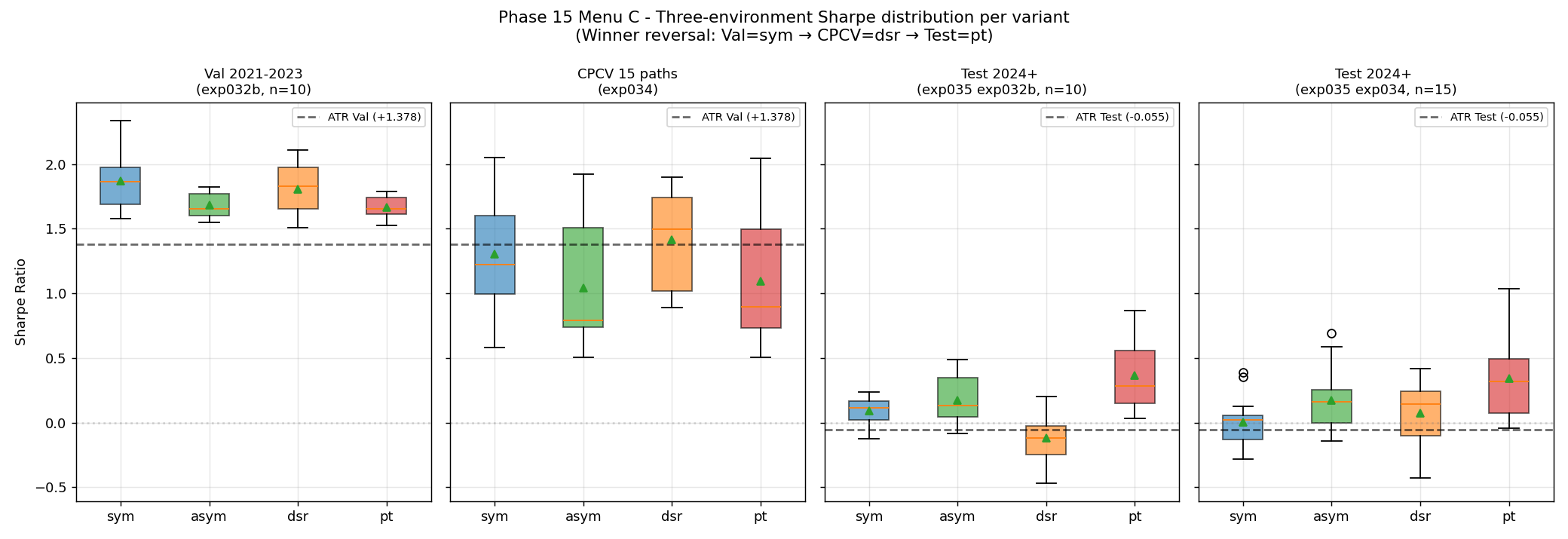
Key finding: the winner reverses across evaluation environments —
Val=sym → CPCV=dsr → Test=pt — and prospect-theoretic reward (pt)
is the only variant that achieves a consistent positive Sharpe on out-of-sample
data, providing quantitative evidence that Kahneman–Tversky prospect theory
confers OOS safety on RL trading policies.
📚 Quick Links
| Resource | Description |
|---|---|
| 📄 Paper (English, 46p) | Final thesis, full method + results |
| 📄 Paper (한국어, 43p) | 한국어판 |
| 📖 Reading Guide | Section-by-section roadmap (interactive HTML) |
| 🗺️ Knowledge Map | RL × Finance prerequisites concept map (interactive HTML) |
| 🎯 Research Question | RQ, hypotheses, scenario branches |
| 📊 Results Summary | All numerical results, 1-page reference |
| 📓 Research Log | Dated decisions and per-experiment logs |
The interactive HTML files (Reading Guide, Knowledge Map) are served via GitHub Pages and open directly in the browser. Local copies are also in
paper/reading_guide.htmlandreports/semester1/week11_knowledge_map.html.
Key Findings
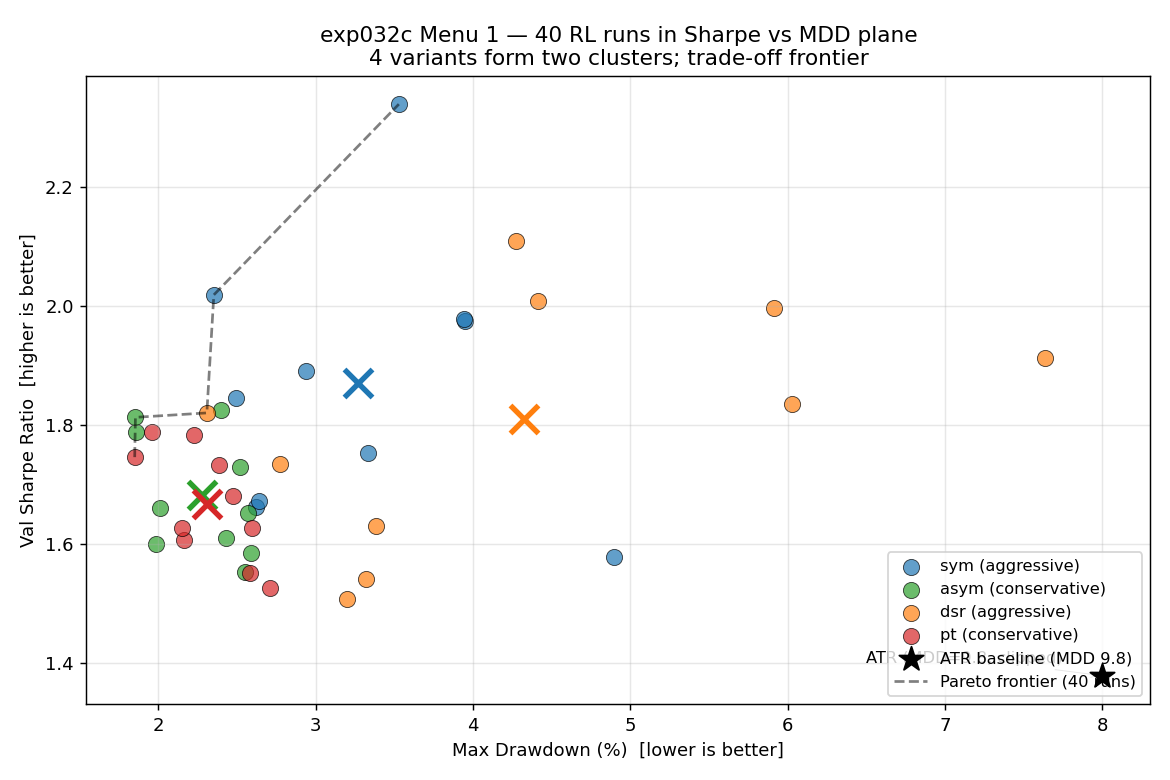
1. Pareto-frontier discovery (two-cluster separation)
Four reward variants partition into two clusters {sym, dsr} (aggressive)
vs. {asym, pt} (conservative) on the Sharpe–MDD plane, with no single
Sharpe winner. Within-cluster Cohen’s $|d| < 0.30$ versus across-cluster
$|d| > 0.79$ (Section 5).
2. Three-environment winner reversal
- Val (single-split):
sym$= 1.871$ - CPCV (multi-split):
dsr$= 1.413$ ($p < 10^{-9}$, Bonferroni 4-way corrected) - Test (out-of-sample):
pt$= 0.367 / 0.339$ (consistent across two model sources, $p < 0.002$)
The winner reverses completely across the three evaluation environments (Section 7).
3. H5 — Prospect Theory confers OOS safety on RL policies
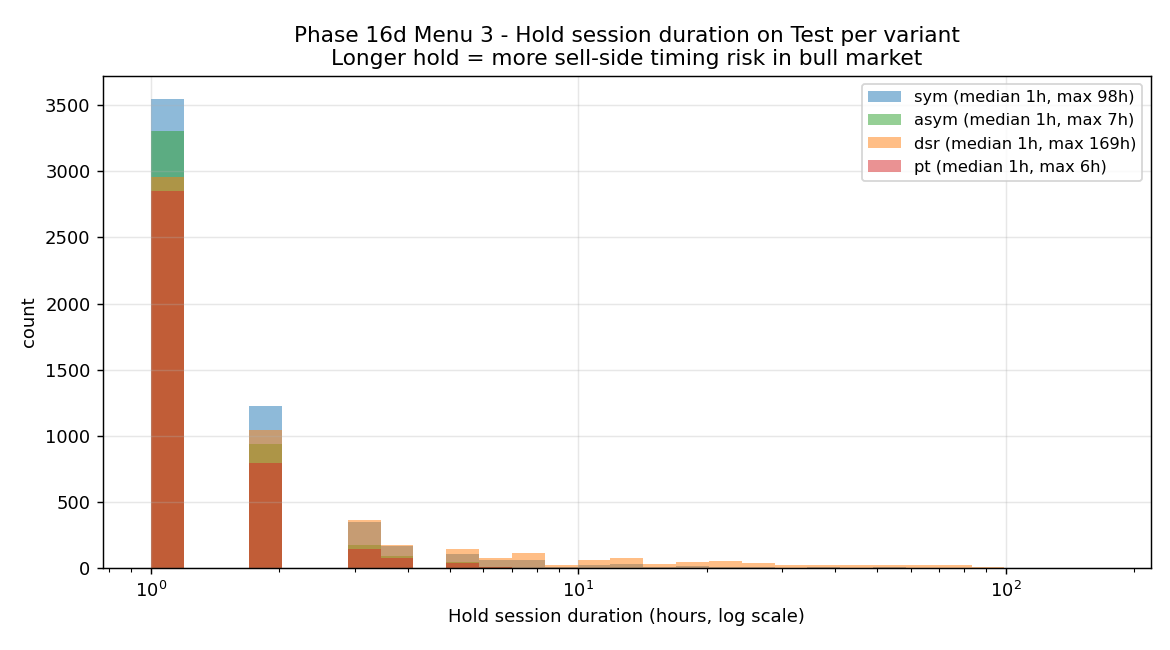
Trajectory analysis shows that pt’s loss aversion ($\lambda = 3.30$) and
concave gain ($\alpha = 0.68$) train policies to exit within mean 1.4 h
(max 6 h), avoiding sell-side timing risk in the unseen bull regime. In
contrast, dsr learns long holding (mean 4.58 h, max 169 h = 7 days) and
records the worst OOS performance — the same reward formulation simultaneously
drives both in-sample advantage and OOS failure (Section 7.3).
4. Methodological recommendation
Single-split Val + multi-split CPCV + out-of-sample Test are jointly required; in-sample diversity (CPCV) does not guarantee OOS consistency (Section 8.3).
Selected Figures
Pareto frontier on Val (two-cluster separation)
40 runs (4 variants × 10 seeds) form two clusters on the Sharpe–MDD plane; 5 runs are Pareto-optimal.
Mechanism — Hold duration on Test
DSR learns long holding (max 7 days) while pt exits within 6 hours,
explaining the OOS reversal.
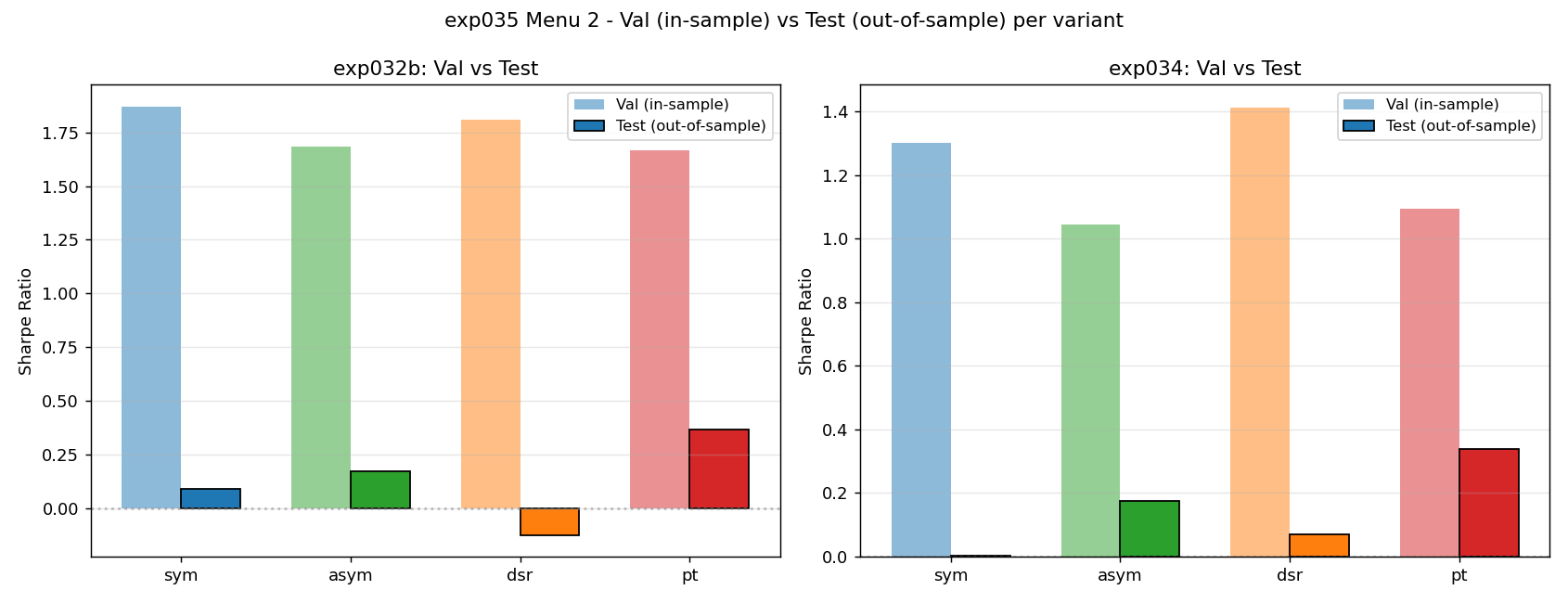
Val → Test generalization gap
All variants degrade by ~1.5 Sharpe; pt’s gap is the smallest
(−0.75 to −1.30); asym and pt are the only variants achieving positive
Test Sharpe with statistical significance.
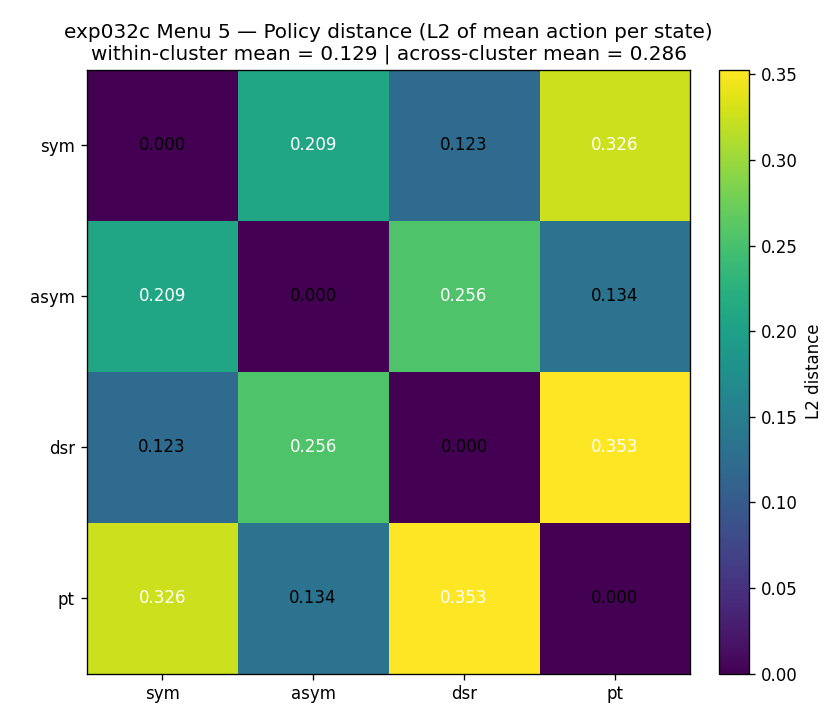
Cluster preservation via policy distance
Within-cluster $L_2$ distance 0.129 vs. across-cluster 0.286 (ratio $2.22\times$) quantifies the two-cluster separation at the policy level.
Repository Structure
capstone-rl-trading/
├── paper/                         # Final thesis (LaTeX)
│   ├── main.tex / main.pdf            # English (46 pages)
│   ├── main_ko.tex / main_ko.pdf      # Korean (43 pages)
│   ├── references.bib
│   ├── READING_GUIDE.md / reading_guide.html
│   ├── figures/, guide_figures/, presentation_prep/
│   └── archive/                       # v1 drafts
├── docs/                          # Design + reference documents
│   ├── PROJECT_GOAL.md                # RQ, hypotheses, scope
│   ├── PAPER_OUTLINE.md               # 9-chapter outline
│   ├── RESULTS_SUMMARY.md             # 1-page numerical reference
│   ├── MDP.md, FORMULAS.md, ENV_HISTORY.md, RELATED_WORK.md
│   └── study/                         # Learning notes (rl_finance/, etc.)
├── src/                           # Production code
│   ├── env/                           # trading_env.py (Env-v4 canonical)
│   ├── agents/                        # PPO agent + baselines
│   ├── evaluation/                    # Metrics + behavior analysis
│   └── utils/                         # Config loader
├── scripts/                       # Command-line entry points
│   ├── train/, analyze/, tune/, data/, build/
├── config/                        # YAML experiment configs (exp030 ~ exp035)
├── experiments/
│   ├── archive/                       # Phase 1-2 (exp001 ~ exp031), outdated
│   └── exp032b ~ exp035/              # Main paper experiments
├── reports/
│   ├── exp032b ~ phase16d/            # Per-experiment analysis.md + figures/
│   └── semester1/                     # Weekly presentations (week02 ~ week11)
├── tests/                         # 46 environment unit tests
├── data/                          # processed/ (parquet, gitignored)
├── CLAUDE.md                      # Project briefing for Claude Code agents
├── README.md                      # This file
├── RESEARCH_LOG.md                # Dated decisions, per-experiment 6-section logs
├── ROADMAP.md                     # Phase status
├── CITATION.cff                   # Citation metadata
└── LICENSE                        # MIT (code); paper/LICENSE for CC BY 4.0
Reproduction
Environment
- Python 3.13 (any 3.11+ works)
- Dependencies:
pip install -r requirements.txtor usepyproject.toml - Core:
stable-baselines3==2.8.0,gymnasium==1.2.3,optuna==4.8.0,pandas,numpy,matplotlib,scipy
Data
python scripts/data/download_data.py     # ccxt Binance API, BTC/USDT 1h
python scripts/data/preprocess_data.py   # adds ATR, log_price, z-scores
# → data/processed/btc_{train,val,test}.parquet
Train 2017-08 ~ 2020-12 / Val 2021-01 ~ 2023-12 / Test 2024-01 ~ (sealed until §7.3).
Train (4 reward variants × 10 seeds × 1M steps, ≈ 3.5 h)
# §3.4 — Optuna hyperparameter tuning for each variant (~2 h)
python scripts/tune/tune_reward_optuna.py

# §5 — main comparison
python scripts/train/run_exp032b.py
Analyze (mechanism, §6)
# §6 — trajectory collection (5 min) + 5-menu mechanism analysis
python scripts/analyze/run_exp032c_eval.py \
    --eval-data data/processed/btc_val.parquet \
    --out experiments/exp032c_trajectories.parquet
python scripts/analyze/analyze_exp032c.py
Robustness (§7)
# §7.1 Slippage 0.02%
python scripts/train/run_exp032b.py \
    --config-tmpl "config/exp033_{variant}_config.yaml" \
    --csv experiments/exp033_summary.csv --exp-tag exp033

# §7.2 CPCV 6-fold (15 paths × 4 variants, ≈ 5 h)
python scripts/train/run_exp034_cpcv.py

# §7.3 Final OOS test set (single-shot, ≈ 20 min)
python scripts/train/run_exp035_test.py
python scripts/analyze/analyze_exp035.py
Build paper
cd paper
xelatex main_ko.tex && bibtex main_ko && xelatex main_ko.tex && xelatex main_ko.tex
pdflatex main.tex   && bibtex main    && pdflatex main.tex   && pdflatex main.tex
Limitations
The paper’s §8.5 documents the following limitations:
- BTC single asset. Multi-asset extension is explicitly out of scope.
- Single OOS regime. Test (2024–2026) is a BTC bull market only; bear or sideways regimes are not evaluated.
- Single slippage level (0.02%). Slippage sensitivity scan and full Domain Randomization are deferred to future work.
- 1M training steps per seed. Longer training may shift winner reversal patterns.
- Phase 2 prior evidence (an Env-v3 asym run with Test Sharpe 1.955) is not reproduced on the canonical Env-v4 environment, demonstrating that environment dependence exceeds reward-variant effect in absolute alpha.
📑 Citation
If you use this work, please cite:
@thesis{lee2026reward,
  author  = {Lee, Chanhee},
  title   = {The Effect of Reward Function Design in RL-Based BTC Grid Trading:
             Pareto Frontier, Winner Reversal, and OOS Robustness of
             Prospect-Theoretic Reward},
  school  = {Seoul National University of Science and Technology},
  type    = {Bachelor's thesis},
  year    = {2026},
  month   = jun,
  url     = {https://github.com/cosmicpotato2047/capstone-rl-trading}
}
Or use the GitHub “Cite this repository” button (powered by
CITATION.cff).
License
- Code (
src/,scripts/,tests/,config/): MIT License - Paper, figures, and documentation (
paper/,docs/,reports/): Creative Commons Attribution 4.0 International (CC BY 4.0)
You are free to use, modify, and distribute the code under MIT. For the paper and figures, attribution is required.
Author
Chanhee Lee (이찬희)
Department of Computer Science, Seoul National University of Science and Technology
happilyfly@seoultech.ac.kr